QS Cloud Examples
This page shows detailed examples for creating JWTs for Qlik Sense Cloud.
Prerequisites
Before using JWTs with Qlik Sense Cloud, you need:
- A JWT Identity Provider configured in your Qlik Cloud tenant
- A certificate/private key pair (or let qs-jwt create one)
- The issuer and key ID values from your JWT IdP configuration
JWT IdP Configuration
These days (May 2023) JWTs are enabled on all Qlik Cloud tenants by default. In the past this feature was enabled for tenants only on a case-by-case basis - that is no longer the case though.
Mode 1: Using Existing Private Key File
The concept is identical to using QSEoW, but adapted for QS Cloud requirements.
Running qs-jwt on macOS
This example will:
- Create a JWT for Qlik Sense Cloud (the
create-qscloudcommand) - The JWT will expire in 365 days
- The private key in file
privatekey.pemwill be used to sign the JWT - Set claims for useremail and username to
[email protected]andAnna Anderson, respectively - Set claim for verified email address to
true - The issuer option must match ditto specified in the Qlik Sense JWT IdP (Identify Provider)
- The keyid option must match ditto specified in the Qlik Sense JWT IdP
- Two groups are defined for this user:
group1andgroup 2
Command (assuming the qs-jwt binary is available in the current directory):
./qs-jwt create-qscloud \
  --username "Anna Anderson" \
  --useremail "[email protected]" \
  --useremail-verified true \
  --issuer "<your-tenant>.eu.qlikcloud.com" \
  --keyid "<your-key-id>" \
  --expires 365d \
  --cert-privatekey-file ./privatekey.pem \
  --groups group1 "group 2"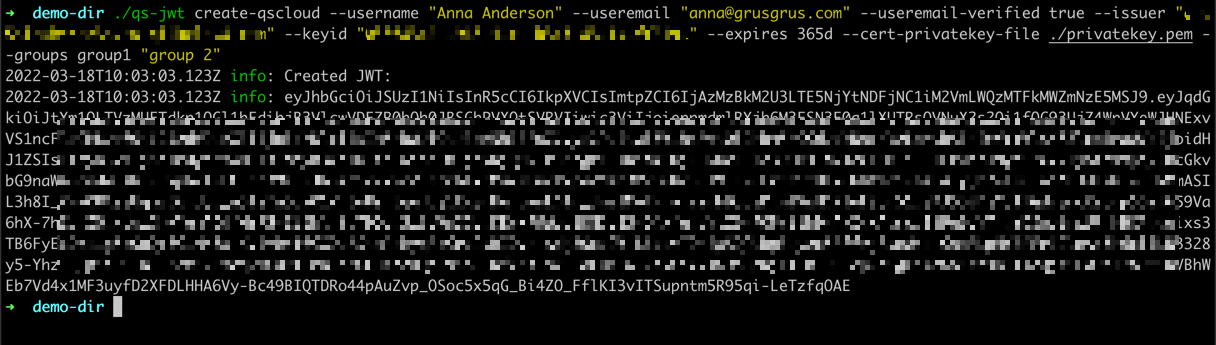
Running qs-jwt on Windows Server
This example uses a private key that was created using openssl.
No groups are included in the JWT in this example.
Remember: Don't forget to unblock the downloaded qs-jwt ZIP file before unzipping it. Failing to unblock it may prevent proper execution of qs-jwt.exe.
qs-jwt.exe create-qscloud `
  --username "Anna Anderson" `
  --useremail "[email protected]" `
  --useremail-verified true `
  --issuer "<your-tenant>.eu.qlikcloud.com" `
  --keyid "<your-key-id>" `
  --expires 365d `
  --cert-privatekey-file ./privatekey.pem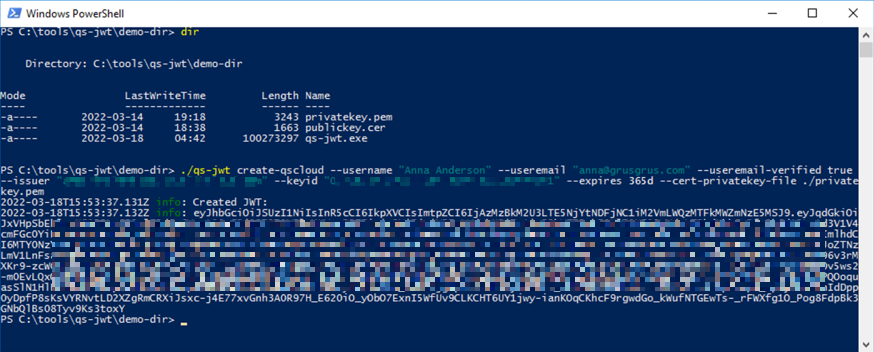
Mode 2: Using Existing Private Key as Parameter
Same concept as for QSEoW, but adapted for QS Cloud.
Running qs-jwt on macOS
This example will:
- Set the environment variable
QSJWTPRIVKEYto the contents of the private key inprivatekey.pemfile - Create a JWT for Qlik Sense Cloud (the
create-qscloudcommand) - The JWT will expire in 365 days
- The private key in environment variable
QSJWTPRIVKEYwill be used to sign the JWT - Set claims for useremail and username to
[email protected]andAnna Anderson, respectively - Set claim for verified email address to
true - The issuer option must match ditto specified in the Qlik Sense JWT IdP (Identify Provider)
- The keyid option must match ditto specified in the Qlik Sense JWT IdP
- Two groups are defined for this user:
group1andgroup 2
Commands:
export QSJWTPRIVKEY=$(cat ./privatekey.pem)./qs-jwt create-qscloud \
--username "Anna Anderson" \
--useremail "[email protected]" \
--useremail-verified true \
--issuer "<your-tenant>.eu.qlikcloud.com" \
--keyid "<your-key-id>" \
--expires 365d \
--cert-privatekey "$QSJWTPRIVKEY" \
--groups group1 "group 2"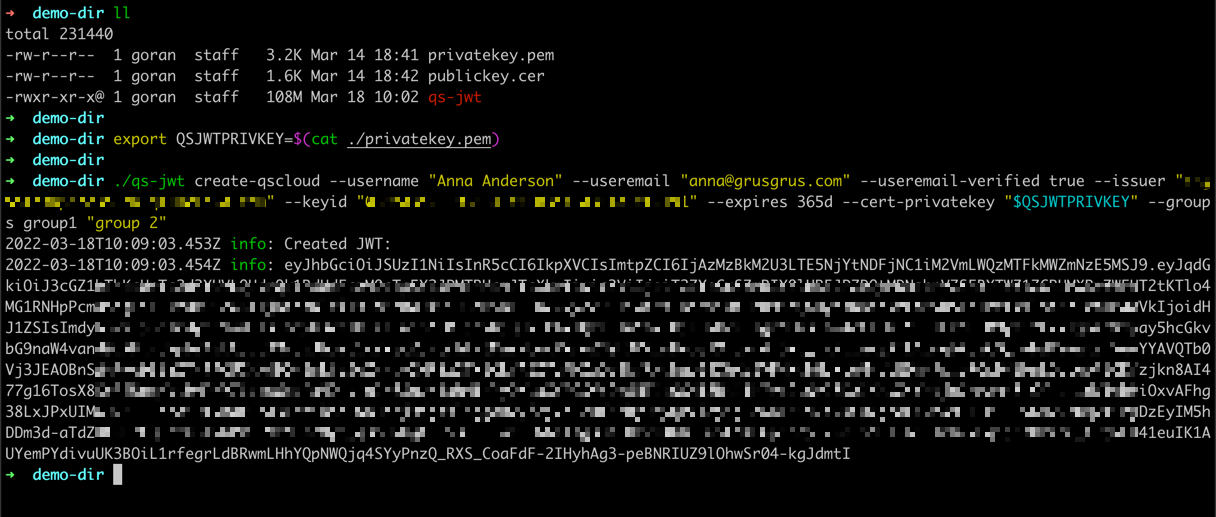
Running qs-jwt on Windows Server
This example uses a private key that was created using openssl.
Here PowerShell is used to run qs-jwt, with the private key stored in an environment variable.
Remember: Don't forget to unblock the downloaded qs-jwt ZIP file before unzipping it. Failing to unblock it may prevent proper execution of qs-jwt.exe.
$QSJWTPRIVKEY = Get-Content .\privatekey.pem -Raw.\qs-jwt.exe create-qscloud `
--username "Anna Anderson" `
--useremail "[email protected]" `
--useremail-verified true `
--issuer "<your-tenant>.eu.qlikcloud.com" `
--keyid "<your-key-id>" `
--expires 365d `
--cert-privatekey "$QSJWTPRIVKEY" `
--groups group1 "group 2"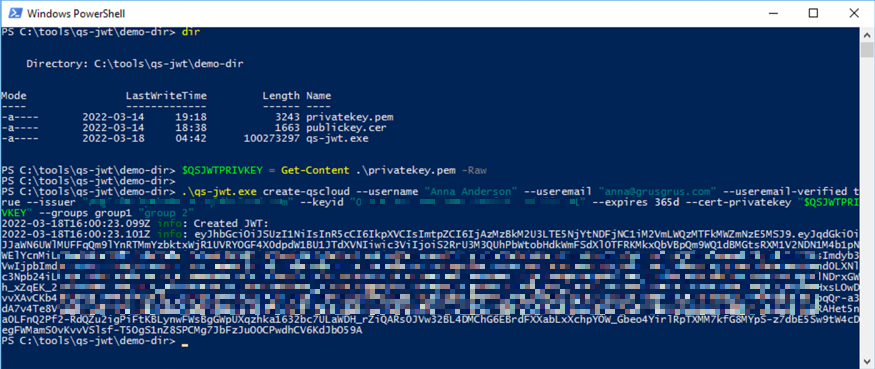
Mode 3: Create New Certificate and Key Pair
If you do not have a certificate with associated private key (PEM encoded) qs-jwt can create these for you.
You will get a complete public-private key pair + certificate based on the private key, rather than just the private key (which is what qs-jwt uses).
The created certificate and keys will be stored on disk as privatekey.pem, publickey.pem and publickey.cer.
An optional prefix can be added to the file names, this is done by using the --cert-file-prefix option.
Running qs-jwt on macOS
This example will:
- Create a JWT for Qlik Sense Cloud (the
create-qscloudcommand) - The JWT will expire in 365 days
- A new private/public key pair will be created, as well as a new certificate based on that private key
- The created files will be prefixed with
qsjwt_ - The created certificate will expire in 400 days
- The newly created private key will be used to sign the JWT
- Set claims for useremail and username to
[email protected]andAnna Anderson, respectively - Set claim for verified email address to
true - The issuer option must match ditto specified in the Qlik Sense JWT IdP (Identify Provider)
- The keyid option must match ditto specified in the Qlik Sense JWT IdP
- Two groups are defined for this user:
group1andgroup 2
Command:
./qs-jwt create-qscloud \
  --username "Anna Anderson" \
  --useremail "[email protected]" \
  --useremail-verified true \
  --issuer "<your-tenant>.eu.qlikcloud.com" \
  --keyid "<your-key-id>" \
  --expires 365d \
  --cert-create true \
  --cert-create-expires-days 400 \
  --cert-file-prefix "qsjwt_" \
  --groups group1 "group 2"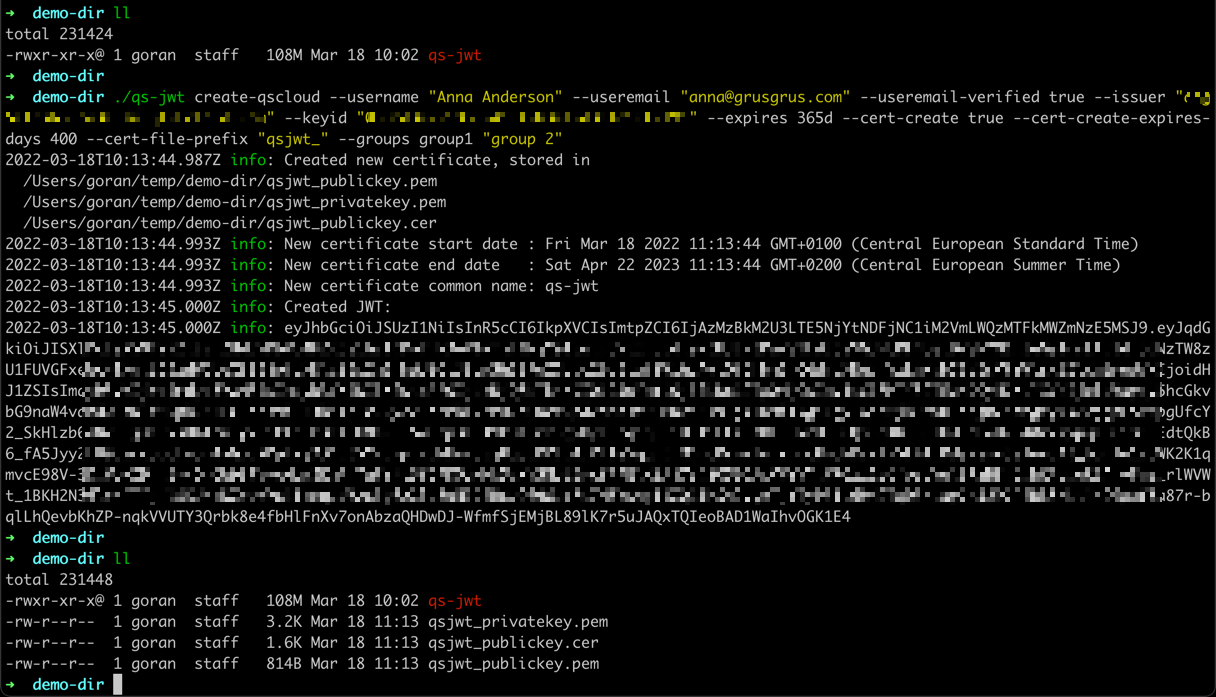
Running qs-jwt on Windows Server
Here cmd.exe is used to run qs-jwt, PowerShell works equally well.
Remember: Don't forget to unblock the downloaded qs-jwt ZIP file before unzipping it. Failing to unblock it may prevent proper execution of qs-jwt.exe.
.\qs-jwt.exe create-qscloud `
  --username "Anna Anderson" `
  --useremail "[email protected]" `
  --useremail-verified true `
  --issuer "<your-tenant>.eu.qlikcloud.com" `
  --keyid "<your-key-id>" `
  --expires 365d `
  --cert-create true `
  --cert-create-expires-days 400 `
  --cert-file-prefix "qsjwt_" `
  --groups group1 "group 2"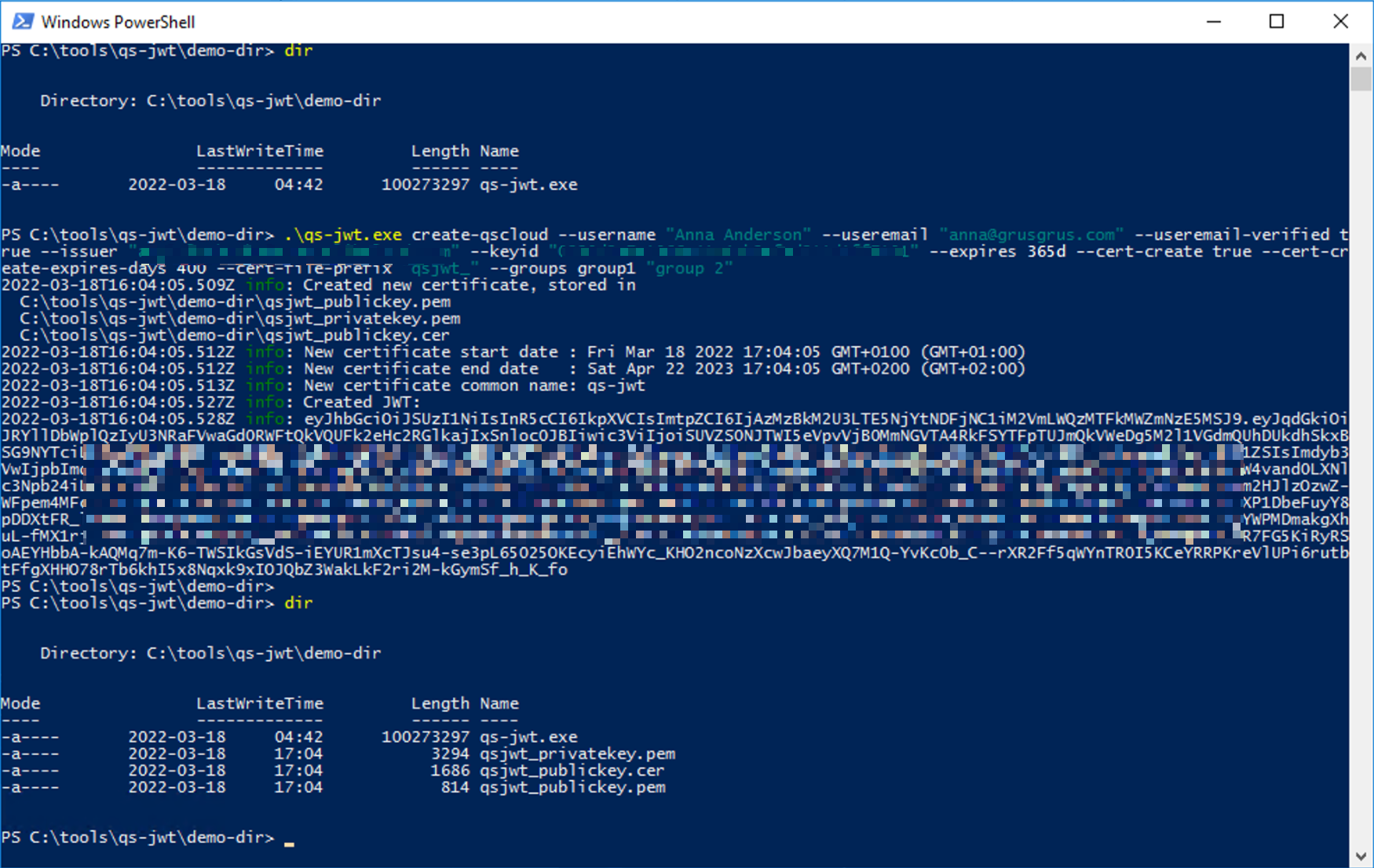
Minimal JWT (without username and email)
The --username and --useremail options are optional. If your integration only needs a stable user ID, you can create a JWT with just the core claims:
./qs-jwt create-qscloud \
  --issuer my-jwt-idp \
  --keyid my-key-id \
  --expires 1h \
  --cert-privatekey-file /path/to/private.pem
TIP
--useremail-verified is only needed when you also pass --useremail.
This is useful for service accounts and automated integrations where display name and email are not available or not needed.